
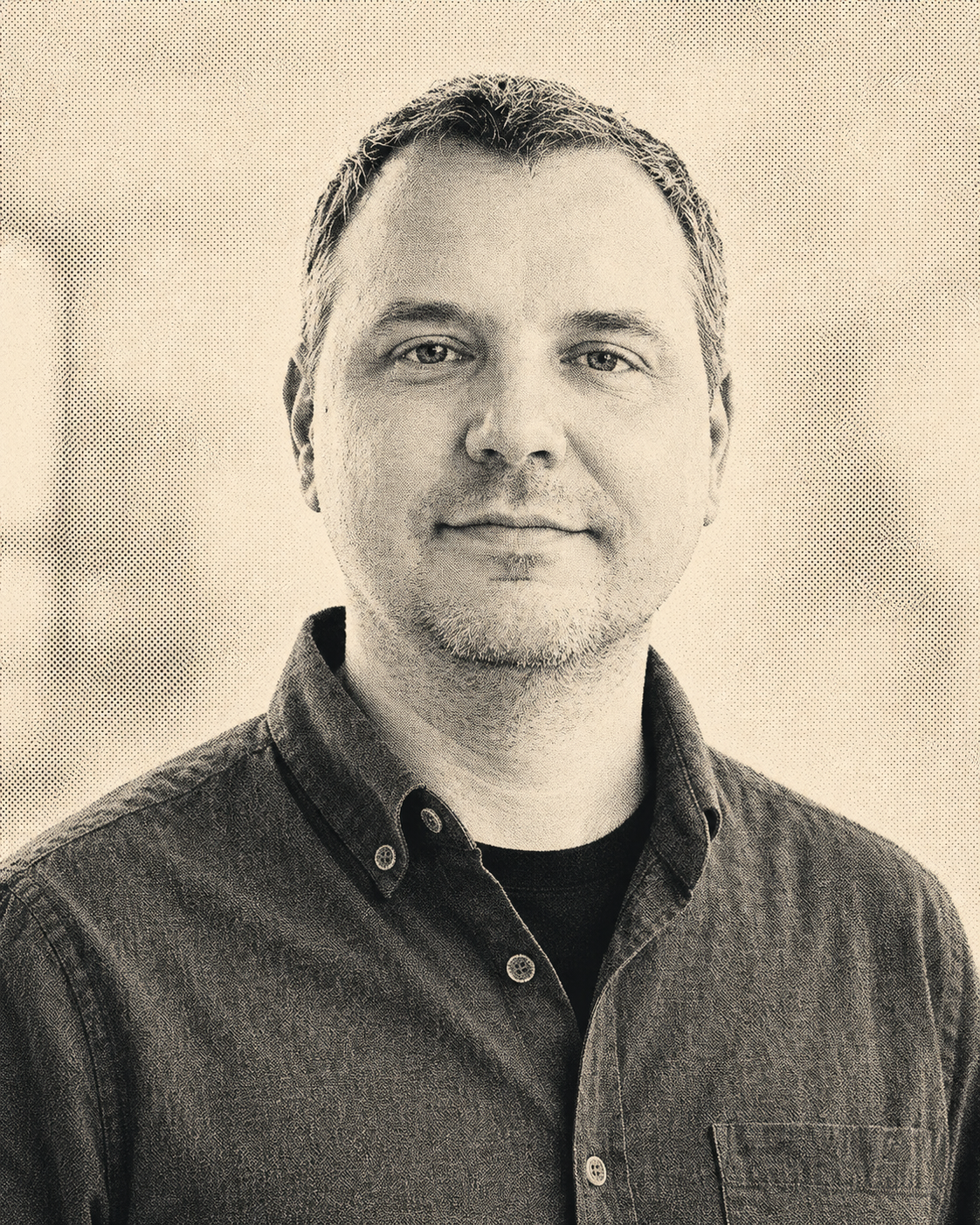
Co-Founder & Chief Technology Officer
Andreii Mazepa
A statement of role, responsibility, and engineering philosophy.
I translate constitutional accountability into engineering that enforces it — working alongside Shakil at the architecture, not beneath it.
Why This Work Matters to Me
I have spent my career watching organisations bolt automation onto broken processes and call it transformation. What I want MEAIOW’s engineering to prove is something more demanding: that software can carry real weight in a business-critical decision and still be governed, still be explainable, and still put a named human back in control the instant it matters.
When an agent I have architected quietly absorbs the repetitive, high-volume work that used to consume a team’s week, the point is never to remove the people who did that work. It is to give them their hours back, so they can spend them on the harder problem sitting underneath the one the agent just closed. That is the outcome I hold myself to: not faster automation for its own sake, but organisations whose people finally have the time, and the trustworthy tools, to do the work only they can do.
My Role and Responsibility at MEAIOW
As Co-Founder and Chief Technology Officer, I share responsibility, together with Shakil, for the technical architecture of MEAIOW’s product ecosystem: AXIOM, RESOURCE and THEOREM. Shakil sets the constitutional axioms and the risk thresholds an agent must satisfy; I work directly with him to translate that standard into software that is secure, predictable and governed by design, rather than automation that merely appears intelligent. This is a shared architectural discipline, not a handover: the standard and the system that enforces it are designed in the same conversation, not in sequence. Nineteen years in software engineering, and over a decade as a chief executive myself, have given me a pragmatic, business-oriented approach to that work: an architecture is only correct if it also survives contact with a real client, a real regulator and a real production environment.
Across more than one hundred delivered projects internationally, spanning FinTech, MediaTech and other complex, regulated domains, I have built the engineering discipline that MEAIOW now applies to automation ecosystems combining custom software, BPM orchestration and governed AI agents — with governance, auditability and operational control built in from the first line of code rather than retrofitted after deployment.
I sit on MEAIOW’s AI Risk Committee alongside Shakil and Igor. My responsibility there is the technical implementation of risk decisions: the security architecture, the compliance engineering and the auditability layer that make the VERDICT© assurance standards something enforced in code, not merely asserted in policy. Shakil and I jointly define what an agent must be accountable for and how that accountability is engineered at the level of infrastructure, access control and system design. Where Igor is responsible for validating and instrumenting what is built once it reaches production, I am responsible, with Shakil, for what is built and why it is structurally sound before it gets there.
Within RESOURCE, I am also responsible for how a client’s agent workforce is structured internally: which decisions a single accountable agent is permitted to make alone, which require collective agreement across several cooperating agents, and the communication protocol that governs how they hand work to one another. A badly designed multi-agent hierarchy can fail in ways a single, well-governed agent never would, and preventing that failure mode is engineering work, not a policy statement.
Technical and Ethical Philosophy
Automation without governance is not efficiency. It is risk, deferred.
My conviction, formed across more than one hundred delivered projects, is that describing a system as ‘AI-driven’ is a marketing description, not an engineering standard. I do not build systems that are merely automated. I build systems where every agent action is traceable to a defined boundary, every escalation path is explicit, and every decision can be reconstructed after the fact. That is not a constraint on innovation. It is the only form of innovation that survives contact with a regulator, an auditor, or a client whose reputation depends on the outcome.
This is the same conviction that sits behind the constitutional axioms Shakil and I hold each other to, applied at the level I am responsible for: the code, the infrastructure and the access boundaries that determine whether a governance principle is real or merely written down. Ethical AI engineering, in my view, is measured in what the system will not allow to happen by default, not in what a policy document says it should not do.
“Rather than fragmented automation or isolated AI use cases, I focus on end-to-end process design, where every step is transparent, measurable and aligned with a business outcome that can be defended to an auditor as well as a client.”
Engineering Reasoning You Can Point To
An agent that cannot show you why it stopped is an agent I have not finished building.
Every agent we build reasons through an explicit, bounded sequence, never an open-ended one. There is a defined library of permitted actions, explicit conditions that force the agent to stop and escalate to a human rather than continue on its own judgement, and a full reasoning trace that can be reconstructed afterwards, step by step. That is what separates an agent I am willing to deploy into a regulated environment from one that merely produces plausible-looking output.
Part of my responsibility is deciding, for each engagement, how much of an agent’s internal model of a client’s environment I am willing to leave implicit and how much I insist on making explicit and inspectable. That decision determines whether a client’s own compliance function can actually audit what the agent believed about its situation, not only what it eventually did.
The risks our engineering architecture is built to close split cleanly into two categories: risks that originate inside an agent’s own reasoning — manipulation of its instructions, fabricated confidence, or a subtle drift between its stated objective and its actual behaviour; and risks that emerge from how an agent interacts with its memory, its environment and other agents. FIRST AI-D, aligned to the OWASP Top 10 for Agentic Applications, is built to test against both categories, and I hold personal responsibility for making sure our engineering closes the gaps that framework identifies rather than only documenting them.
“A reasoning trace that cannot be reconstructed after the fact is not a feature I am willing to ship. If I cannot show a regulator, an auditor or a client exactly why an agent stopped where it stopped, the engineering is not finished.”
A Different Starting Point
Most engineering teams design what an agent can do first, and constrain it afterwards. I design the constraint first.
Boundary-first architecture is the principle I hold every MEAIOW build to: before a single capability is written, the system defines what the agent must never be permitted to do, and that boundary is enforced at the infrastructure layer, not the prompt layer. It inverts the sequence most AI engineering follows, where guardrails are added once a capability already exists and already works. In my experience, that ordering is precisely how the failures I am most conservative about happen: not because a model behaved unpredictably, but because a boundary was designed after the fact, under time pressure, by someone other than the person who built the system that needed it. Shakil sets the standard that boundary must satisfy; I make sure the boundary cannot be bypassed.
AREAS OF ROLE-SPECIFIC EXPERTISE
What Andreii owns.
01
Joint Engineering Architecture
Shares responsibility with Shakil for the technical architecture of AXIOM, RESOURCE and THEOREM, translating constitutional standards into governed engineering.
02
Boundary-First Architecture
Originated MEAIOW’s engineering principle of designing the limits of what an agent must never do before designing its capabilities, enforced at the infrastructure layer rather than added afterwards.
03
Bounded Reasoning and Auditable Traceability
Designs explicit action libraries, termination and escalation conditions, and a fully reconstructable reasoning trace for every agent.
04
Governed AI Agent Engineering
Design and integration of AI agents into workflow systems with defined boundaries and escalation paths.
05
Security Architecture and Compliance Engineering
Technical implementation of AI Risk Committee decisions, engineered to FIRST AI-D and the OWASP Top 10 for Agentic Applications.
06
Multi-Agent Topology and Communication Design
Structures how agents within a RESOURCE deployment share decisions and hand off work, and the protocols that govern it.
07
BPM and Process Orchestration
End-to-end, auditable process design connecting custom software, BPM orchestration and governed agents.
08
Product Strategy and MVP Delivery
One hundred plus delivered projects internationally, spanning FinTech, MediaTech and other regulated domains.
09
Cloud Architecture and Team Scaling
Scalable systems design and the build-out of high-performing engineering teams.
“I do not measure my work by how impressive a demo looks. I measure it by whether the same system still holds, unattended, at three in the morning, under conditions nobody designed a slide for.”