
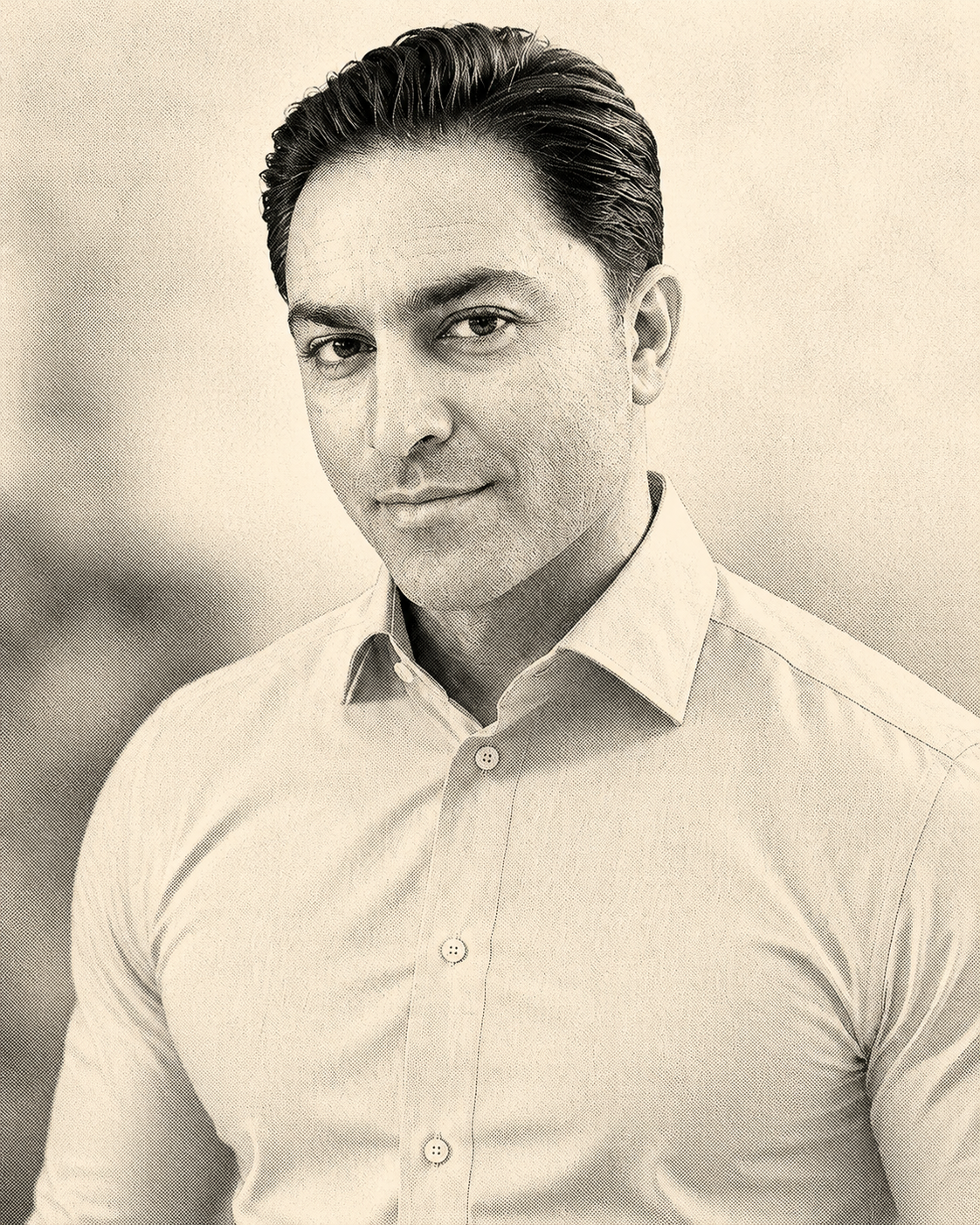
Founder & Chief Executive Officer
Shakil Siddiqui
A statement of role, responsibility, and technical and strategic philosophy.
The architect of the category — accountable for the strategic direction, the technical constitution, and the engineering standard every system is built against.
Why This Work Matters to Me
I did not build MEAIOW because I wanted to lead an AI company. I built it because I have spent twenty-seven years watching capable people and capable institutions fail, not for lack of talent, but for lack of infrastructure: in flood zones, in under-resourced hospitals, in courtrooms, in boardrooms that made irreversible decisions without the evidence base they deserved. Artificial intelligence is the first tool in my lifetime with the power to close that gap at civilisational scale — but only if it is governed well enough to be trusted by the people who need it most.
I think of this as widening the field of what a human mind is free to attend to: less time defending against repetitive, governance-heavy risk, and more time for the judgement, creativity and care that human attention is actually for. My personal measure of MEAIOW’s success is not how advanced the technology becomes. It is how many under-resourced organisations, and the people inside them, gain a workforce advantage that used to belong only to the most powerful institutions on earth.
My Role and Responsibility at MEAIOW
As Founder and Chief Executive Officer, I hold ultimate strategic and technical accountability for MEAIOW. I am the author of the MEAIOW Constitution, the governing document defining how every AI agent colleague we build reasons, acts and remains accountable — structured across sixteen agent axioms in four clusters and operationalised through the MEAIOW Cognitive Loop. This is not a document I commissioned. It is a document I wrote and continue to maintain myself, because the architecture of governed intelligence cannot be delegated by the person ultimately answerable for it.
I chair MEAIOW’s AI Risk Committee alongside Andreii and Igor, and I hold personal accountability for every risk decision taken across our client engagements. I set the strategic direction for CONTINUUM, our seven-stage, five-pillar Agentecture Workforce Strategy methodology, and I co-designed VERDICT©, our testing and assurance framework, selecting it from eight naming and structural alternatives after formal conflict risk analysis. I lead MEAIOW’s engagement with government bodies, regulators and international agencies across the UK, UAE, Singapore, Japan and the United States.
My academic instincts were never confined to a single discipline. Business management and strategy sat alongside computer science, artificial intelligence and workforce management as equal, overlapping passions throughout my life — not as separate subjects but as one continuous question: what actually separates a competent employee, or a competent team, from a genuinely winning one, and what has to be true of the systems around them for that to happen by design rather than by chance. That question, tested for twenty-seven years across trading, humanitarian and social-impact ventures, retail and franchise leadership, and industrial and technology sectors, is the direct intellectual root of Agentecture: the conviction that instilling a winning skill set follows the same underlying discipline, whether the colleague being developed is a person or an agent.
I work directly alongside Andreii on the technical architecture of AXIOM, RESOURCE and THEOREM: he and I jointly hold the architectural standard that every system must satisfy, and I sit inside the design reviews, the risk sign-offs and the boundary-setting decisions as a technical participant, not a strategic observer receiving a summary afterwards. Where Andreii and Igor lead the engineering build and the production execution of our platforms, I set — and remain personally engaged in — the constitutional and technical framework within which that execution happens. The three roles are separate and, deliberately, cannot substitute for one another.
Every product decision at MEAIOW is measured against a test I set personally: would this agent be good enough to hire, and would the people working alongside it actually want to. An agent that is technically capable but treats the humans around it as an afterthought fails that test as completely as one that is personable but unreliable. We are not building tools that happen to talk. We are building colleagues, engineered to a standard most human hiring processes could not survive.
Technical and Ethical Philosophy
Every axiom I wrote exists because I have seen, first-hand, what happens when a system fails without one.
I hold a non-negotiable position on artificial intelligence: it is a governance discipline before it is a technology discipline. The sixteen axioms in the MEAIOW Constitution, and the Cognitive Loop that operationalises them, are grounded in original cognitive and neurological science research, not in generic industry frameworks. They exist because I have stood in environments — disaster response, energy trading, regulated healthcare commerce and complex infrastructure operations — where an ungoverned system was never a hypothetical risk. It was the difference between an outcome that could be trusted and one that could not.
I am directly involved in the technical judgement calls MEAIOW makes about agent boundaries, escalation thresholds and human oversight points — working system by system alongside Andreii and Igor, not as a strategic sponsor reviewing summaries, but as the person who wrote the constitutional standard those decisions are tested against and who remains present in the room where the engineering meets that standard.
“I did not build MEAIOW to be the most technical person in the room, or the most commercial. I built it to be the person who holds both together, in the same conversations and at the same table where Andreii and Igor build the systems that make that accountability real.”
Grounded Beyond Opinion
An architecture is only as strong as the proof behind it, not the confidence with which it is presented.
When I designed the MEAIOW Cognitive Loop, I built it around a mental state made of distinct, interacting faculties: memory, an internal model of the environment, a sense of goal and priority, and a mechanism for weighting reward and urgency, all continuously updated as an agent perceives, reasons and acts. I did not build it to resemble anyone else’s research. I built it because the same cognitive and neurological science any serious architecture must be grounded in leads, independently, to that same structure. Recent, large-scale, cross-institutional academic research into brain-inspired agent design has since converged on a strikingly similar shape. It is the difference between an architecture I can defend under scrutiny and one I can only assert.
Most agent platforms bolt memory, reasoning and safety together as separate afterthoughts, added one at a time as problems appear. MEAIOW’s Cognitive Loop was never built that way. It was designed as one integrated architecture from the outset — which is the same conclusion the wider research community now appears to be reaching about what a genuinely capable, safely governed agent actually requires.
For the same reason, we do not claim that any MEAIOW agent is conscious or has any subjective experience of its own, and I am careful of language that implies otherwise. Every agent goal in a MEAIOW deployment remains externally set and bounded by design. Current academic research is explicit that giving an AI system open-ended, self-generated motivation is a live safety concern rather than a solved problem, and I treat that as a design constraint for MEAIOW today, not a feature to add once it becomes technically possible.
“Intelligence that cannot be shown to work, mathematically and empirically, is not intelligence I am willing to put in front of a client. Arnold’s Cat Map is proof that apparent complexity folds back into structure, if you have done the work to show it. That is the standard I hold MEAIOW to.”
A Different Starting Point
Most AI strategy starts with what a model can do. Mine starts with what happens when it is wrong.
The principle that shapes every autonomy threshold in the MEAIOW Constitution did not come from an AI research paper. It came from twenty-seven years spent in environments where the cost of a wrong decision and the cost of a missed decision were rarely the same size, and where getting that asymmetry wrong was never hypothetical. I built that discipline into MEAIOW as a first-class design principle: an agent’s permitted autonomy is calibrated against the real-world asymmetry between the cost of acting wrongly and the cost of not acting at all, not against task type alone. It is a distinction most AI vendors do not make, because most AI vendors have never had to live with the difference. Andreii and Igor then carry that principle into architecture and into production, so it governs what is built, not only what is written down.
AREAS OF ROLE-SPECIFIC EXPERTISE
What Shakil owns.
01
Category and Constitutional Architecture
Author of the MEAIOW Constitution: sixteen agent axioms across four clusters, and the MEAIOW Cognitive Loop, grounded in original cognitive and neurological science research.
02
Asymmetric Risk Calibration
Originated the calibration principle behind MEAIOW’s agent autonomy thresholds: boundaries set by the real-world asymmetry between the cost of inaction and the cost of a wrong action, not by task type alone.
03
Joint Technical Architecture Authority
Works directly alongside Andreii on the architectural standard governing AXIOM, RESOURCE and THEOREM, holding technical sign-off jointly rather than by delegation.
04
AI Risk Governance
Chairs the AI Risk Committee with Andreii and Igor; personally accountable for every AI risk decision made across client engagements.
05
Methodology Design
Strategic author of CONTINUUM (seven stages, five pillars) and co-designer of VERDICT©, MEAIOW’s testing and assurance framework.
06
Technical Systems Literacy
Hands-on governance of IoT, SCADA and sensor-fusion critical infrastructure systems, translated directly into agent architecture and boundary-setting judgement.
07
Mathematical and Scientific Rigour
Insists every structural claim MEAIOW makes is provable: grounded in probability theory, linear algebra and formal multi-agent inference, expressed visually through Arnold’s Cat Map.
08
Workforce Strategy and Agentecture Design
Twenty-seven years across fourteen industry verticals and five continents designing how teams are structured, measured and motivated to become winning, not merely competent — the direct intellectual root of Agentecture.
09
Global Regulatory and Commercial Relations
Direct engagement with regulators and government bodies across the UK, UAE, Singapore, Japan and the United States.
“I want organisations to trust MEAIOW because any one of the three of us can sit in the same architecture review and explain, at both the strategic and the technical level, exactly why what we have built is safe.”